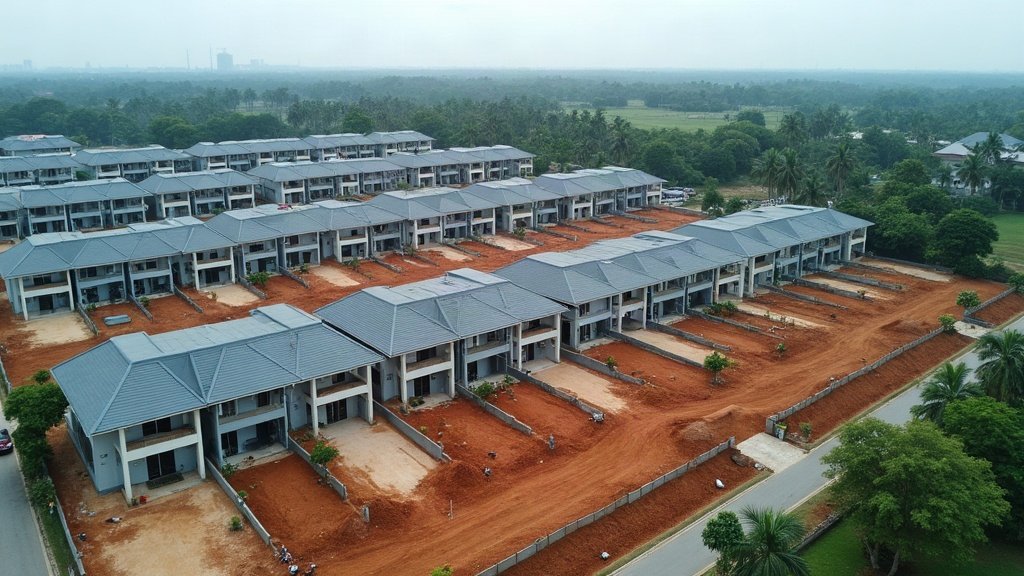
Perak had 4,075 unsold homes on its books at 30 June 2026, and more than 1,000 of them are the single- and double-storey terraces that are meant to be the easy sell in a state like this. State housing and local government exco Sandrea Ng Shy Ching gave the figure at the Malaysia Property Expo in Ipoh on 15 October, and said the state has asked Rehda Perak to study why they have not moved (The Star). A home counts as unsold six months after its launch, she said.
Where the stock sits depends on who is talking. The Star quotes Rehda Perak chairman Ir Loh Ban Ho as saying it is mostly in Manjung, Hilir Perak and Kinta; Utusan Malaysia quotes Ng naming Kinta, Sitiawan and Hilir Perak. Neither report gave price ranges, which is the first thing the study should publish.
The easy reading is that Perak developers have priced too high, or built too much in the wrong places. The state seems to lean that way: Ng said approvals for new projects in areas that already have oversupply will be stricter, and that is sensible. But in Rummah News' view, the more useful clue is in the developers' own numbers, and it points somewhere else first.
The buyers are there; the loans are not
Rehda's national survey of 181 Peninsular members, briefed on 23 September and reported by The Edge, found 77% of them hit financing problems in the first half of 2026, and 84% of those problems were end-financing - buyers' home loans being turned down. Asked why completed homes were sitting unsold, developers put loan rejection first at 30%, ahead of high pricing at 21% and unreleased Bumiputera units at 16%. Rehda secretary-general Carrie Fong put it plainly: "Our problem is the conversion ... because the end-financing is being rejected."
That survey is Peninsula-wide, not a Perak count, and Perak's own study may find a different mix. But a terrace house in Kinta is not a luxury product, and if it is not selling, a buyer who signed a booking form and then failed the bank's test is at least as likely an explanation as a buyer who walked past a price tag. The same survey found 80% of first-half buyers were owner-occupiers and 70% were aged 29 to 44: young families, the borrowers most exposed to tight income tests.
This is why the Budget 2027 stamp duty exemption for first-time buyers, which Ng hopes will lift transactions, can only do so much. It lowers the cost of a purchase the bank has already approved. It does nothing for the buyer the bank has said no to. Loh's own wish list at the expo, reported by Sinar Harian, was about supply - lower compliance costs, faster approvals, better coordination between councils and utility companies - and said little about the loan desk.
There is a version of this study that would actually help Perak buyers: unsold stock broken down by district, price band and the reason each unit fell through, including how many were booked and then lost at loan stage. If loan rejection turns out to be the main reason, the fix sits with banks, guarantee schemes and how developers pre-qualify buyers before they take a booking - not only with the state's approval desk. The expo itself, which ran from 14 to 18 October with 23 developers offering 2,301 units worth an estimated RM1.2 billion, shows there is no shortage of homes on offer.
Sources: The Star, Utusan Malaysia, Sinar Harian, The Edge Malaysia.