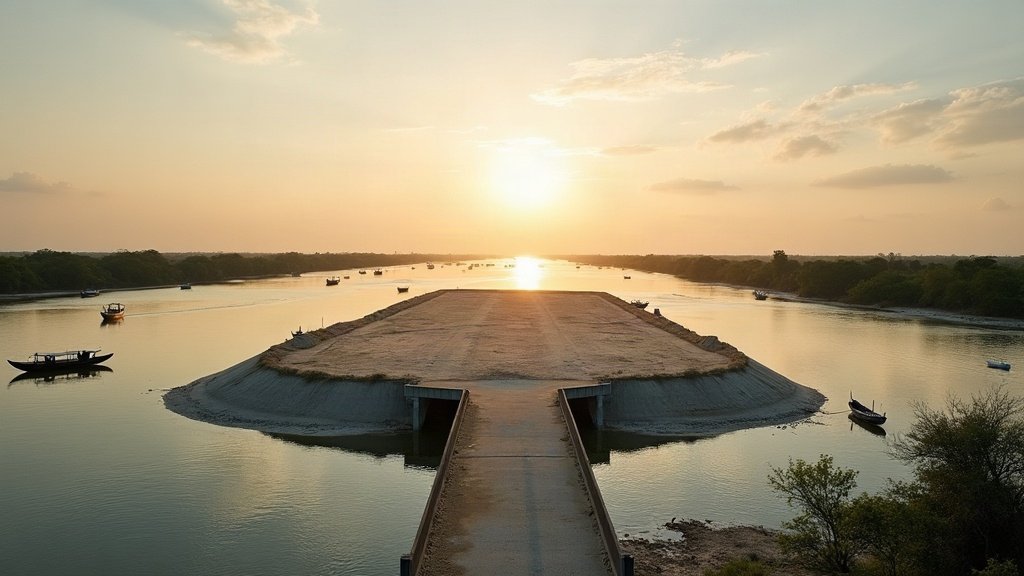
The Johor Bahru-Singapore Rapid Transit System (RTS) Link has passed the 90% completion mark, with cross-border passenger service targeted for the end of 2026. For Johor's property market, the 4km shuttle is shaping up as the single biggest connectivity catalyst in a generation, anchoring demand around the Bukit Chagar terminus.
Where the project stands
The RTS Link surged past 90% completion as of April 2026, with the New Straits Times reporting that the final phase of works is now under way. The line runs roughly 4km between the Malaysian terminus at Bukit Chagar in Johor Bahru and Singapore's Woodlands North station, with a journey time of about five minutes and a peak capacity of up to 10,000 passengers per hour in each direction, according to the Land Transport Authority of Singapore.
The project, jointly delivered by MRT Corp on the Malaysian side, carries an estimated cost of around RM10 billion (about S$3.24 billion). Train testing began in December 2025 and is continuing in stages, while installation of e-gates is complete and the setup of body-screening and baggage-scanning equipment started ahead of the original schedule. Passenger service is targeted for end-2026, with some reporting pointing to a phased ramp-up into January 2027.
Fares are still being finalised. Early estimates put a one-way trip at roughly S$5 to S$7 (about RM15.50 to RM21.70), with the operator, RTS Operations, expected to table proposed rates in the third quarter of 2026. At that price point, the RTS Link would offer a fast, congestion-free alternative to the Causeway, one of the world's busiest land borders, which routinely sees long queues during peak crossings. The two terminals are also designed for co-located immigration clearance, so commuters clear both countries' checks before boarding rather than stopping mid-journey.
Onward connectivity is what turns the shuttle into a genuine commuting option. On the Singapore side, Woodlands North links to the Thomson-East Coast MRT line, giving commuters a one-change ride deep into the city-state; on the Malaysian side, Bukit Chagar sits beside the existing JB Sentral transport hub, with bus and rail feeders into the rest of Johor Bahru. The 4km crossing is therefore only the visible centrepiece of a much wider door-to-door network.
Why it matters for Malaysian readers
The RTS Link does not arrive in isolation. It dovetails with the Johor-Singapore Special Economic Zone (JS-SEZ), which has driven a surge in investment commitments. Johor secured approved investment of RM91.1 billion in the first nine months of 2025, of which the JS-SEZ accounted for 74.6%, or about RM68 billion, with Singapore the single largest source of capital at RM28.5 billion. That investment flow underpins job creation, office demand and, in turn, residential absorption across the southern corridor. The committed capital spans manufacturing, logistics, data centres and financial and professional services, the kind of higher-value employment that tends to bring relocating staff and a deeper pool of qualified tenants rather than purely transient demand.
For housing, the clearest beneficiary is the catchment around Bukit Chagar, JB Sentral and the planned Ibrahim International Business District, where transit-oriented developments are positioned to capture commuters who live in Johor but work in Singapore. A predictable five-minute crossing reshapes the affordability maths for that group: a Johor strata unit bought in ringgit, paired with a Singapore-dollar income, can look compelling against Singapore rents and prices. Readers tracking that thesis can explore property for sale in Johor and review recent transaction data to gauge where pricing has already moved.
The demand pool is sizeable. Hundreds of thousands of people already cross the Causeway daily for work, study and shopping, and a sizeable share of those are Malaysians commuting into Singapore. Shaving an unpredictable, congestion-prone road journey down to a five-minute rail hop changes which neighbourhoods are realistically commutable, pushing interest beyond the immediate city centre to feeder areas served by onward bus and rail links on both sides of the Strait of Johor.
The flip side is execution and timing risk. Property prices around announced infrastructure often run ahead of delivery, and a slip from end-2026 into 2027, or a fare structure higher than expected, could temper near-term rental yields. Johor has also carried a persistent high-rise overhang in past cycles, so buyers should be selective about project location and developer track record rather than assuming the RTS Link lifts every address equally.
Yield expectations should stay grounded. Even with stronger demand, gross rental yields on Johor high-rise stock have historically sat in the low single digits, and a wave of completions tied to the RTS and JS-SEZ story could keep rents competitive for some time. The corridor's earlier large-scale launches are a cautionary reference: ambitious projects can outrun genuine occupier demand if delivery and population catch-up lag the marketing. Sustainable returns will favour well-located, right-sized units close to the terminus over speculative bulk purchases further out.
Editorial commentary
Malaysia's transport ministry has repeatedly stressed that the RTS Link remains on schedule and within budget despite global cost pressures, a reassurance that matters given the long history of stop-start cross-border rail proposals between the two countries. The fact that physical works are now in their final phase, with systems testing already running, lends real credibility to the end-2026 target. It also keeps alive the broader connectivity story for the south, where talk of a revived Kuala Lumpur-Singapore high-speed rail link continues to circulate as a separate, longer-dated prospect.
Rummah News' view is that the RTS Link's property impact will be structural rather than speculative. Unlike a one-off launch, a permanent high-frequency rail connection changes the daily-commute geography of the region for decades. The investors most likely to benefit are those buying near the terminus for genuine rental or owner-occupier demand, not those chasing a quick re-sale on the opening-day headline.
For Malaysian upgraders the calculus is different again. A faster, cheaper commute can make a Johor home viable for a household with one earner working in Singapore, broadening the buyer base beyond pure investors. That mix of genuine owner-occupiers and cross-border renters is exactly the kind of diversified demand that tends to support prices more durably than investor speculation alone, and it is why the southern corridor's fundamentals look sturdier this cycle than in the overhang years.
Practical takeaway
- Focus on the Bukit Chagar and JB Sentral catchment, where the five-minute crossing has the most direct value.
- Model rental demand around a Singapore-dollar income paired with lower ringgit purchase and holding costs.
- Factor in fare uncertainty - one-way trips are estimated at RM15.50 to RM21.70 pending the Q3 2026 announcement.
- Treat the end-2026 target as a guide, not a guarantee; allow for a possible slip into 2027.
- Cross-check JS-SEZ investment momentum (RM68 billion in 9M2025) as a demand indicator for nearby commercial and residential stock.
- Be selective on project and developer given Johor's history of high-rise oversupply; buy for long-term commute fundamentals, not opening-day price spikes.
Closing
As the RTS Link enters its final stretch and fare rates are tabled later this year, expect Johor's southern corridor to stay firmly in the spotlight for both local upgraders and Singapore-based buyers. Rummah News will follow the opening timeline, the Q3 fare announcement and their effect on Johor pricing as details firm up over the coming months.